
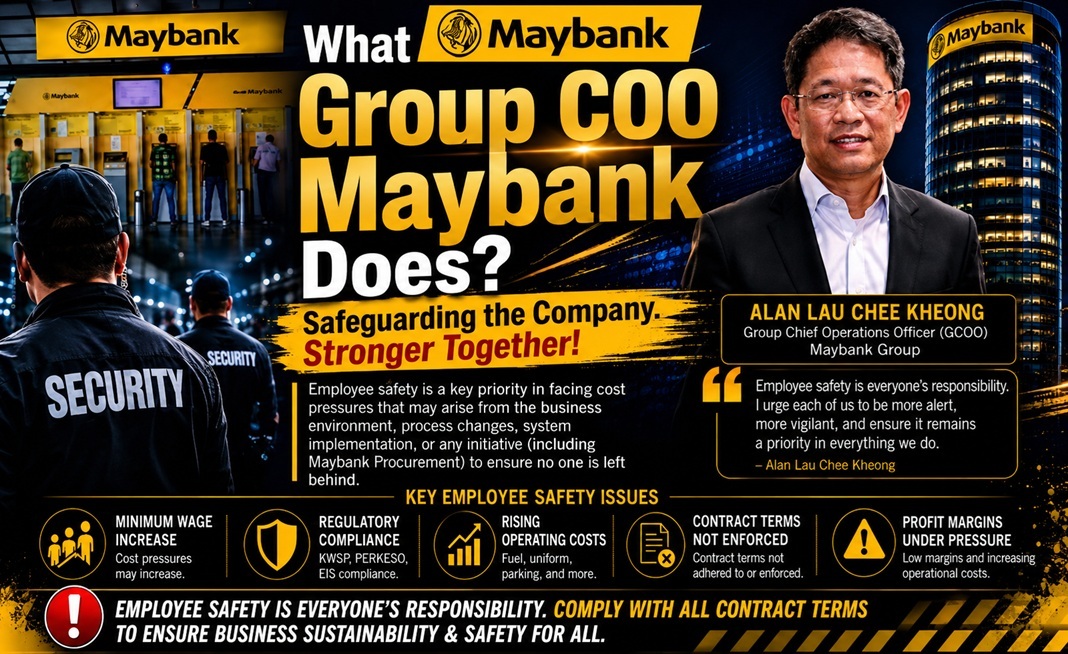
The security services industry claims it is facing increasing financial pressure due to the reluctance of major corporate clients to review existing contract values to reflect the implementation of the new minimum wage mandated by the government.
Industry representatives allege that the situation involves Malaysia’s largest banking institution, Maybank, which is said to be maintaining the original contract terms and is only willing to renegotiate payment rates once the current contracts expire.
The issue arose following the government’s decision to raise the minimum wage from RM1,500 to RM1,700 per month under the Minimum Wage Order, which came into effect in February 2025. However, more than a year after the policy was implemented, industry players claim that contract rates for security services provided at the bank’s premises have yet to be adjusted to account for the legally mandated increase in labour costs.
According to industry sources, security service providers have been forced to absorb the additional costs themselves in order to ensure employees receive the government-mandated minimum wage, despite continuing to receive payments based on outdated contract rates.
Several operators interviewed described the situation as unfair to an industry that is legally required to comply with government regulations, while the financial burden arising from policy changes is not being reasonably shared by the corporate clients benefiting from their services.
“We are legally required to pay our employees according to the government’s minimum wage regulations. Failure to do so exposes us to enforcement action. Yet at the same time, some clients refuse to revise contract rates to accommodate the increased costs,” said one operator who requested anonymity.
Industry sources further noted that a similar situation occurred when the minimum wage was previously increased from RM1,200 to RM1,500, with clients maintaining that they were bound by existing contract terms until the contracts reached their expiry dates.
Industry players argue that compliance with the minimum wage is not merely a commercial matter but a shared responsibility to ensure government policies and laws can be implemented effectively without jeopardising the sustainability of service providers.
They contend that adherence to the minimum wage framework is fundamentally a matter of legal compliance rather than a purely commercial consideration.
According to industry representatives, the failure to align contract values with the current minimum wage could threaten the viability of service providers and undermine efforts to retain workers in the security industry, which already faces persistent manpower shortages.
MAYBANK COO ALLEGEDLY RESISTS IMPLEMENTATION OF NEW RATE
Industry sources also claim that procurement and contract management matters fall under the operational division led by Maybank’s Group Chief Operating Officer (GCOO), Alan Lau Chee Kheong.
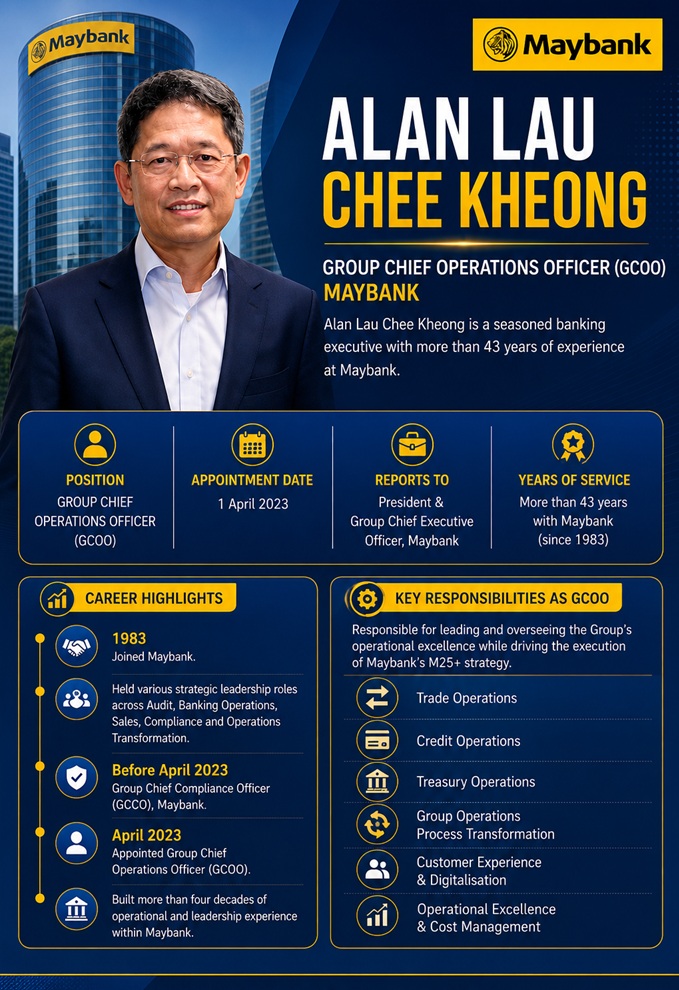
According to the sources, Alan Lau is reportedly in the process of retiring from the banking group.
Alan Lau Chee Kheong, a Singaporean national, is alleged to have disagreed with the implementation of the revised rates proposed by Maybank’s Procurement Department. He is said to hold the view that such adjustments are unnecessary despite the significant increase in operating costs faced by security service providers.
Industry sources have questioned whether Alan Lau’s stance is effectively undermining the Madani Government’s policy initiatives by refusing to implement changes required under government regulations, despite discussions having taken place with industry stakeholders.
Sources further claim that Alan Lau has maintained that any price adjustments can only be considered upon the expiry of existing contracts or through renegotiation in accordance with the provisions of the current agreements.
SECURITY FIRMS APPEAL FOR RENEGOTIATION, SEEK RETROSPECTIVE PAYMENTS
Meanwhile, several security companies have called for renewed negotiations between clients and service providers in order to reach a fair and equitable solution for all parties.
They have also urged that contract rates be adjusted retrospectively from the date the RM1,700 minimum wage came into force, arguing that service providers have already borne the increased costs in order to comply with legal requirements.
According to industry players, the failure to align contract rates with changes to the minimum wage policy has imposed significant financial strain on security companies, particularly those deploying large numbers of guards at corporate client premises.
As a result, several companies are understood to be evaluating various options, including seeking legal advice and considering legal reviews of contracts that allegedly fail to take into account mandatory changes introduced through the government’s Minimum Wage Order.
Nevertheless, industry representatives say they hope a resolution can be achieved through negotiation before any further action is taken.